
What Is Inner Life?
Inner Life explores how human beings become more integrated, present, and capable through direct experience. It does so by cultivating the capacities through which we perceive, participate in, and respond wisely to life.
Inner Life is a living system of embodied human development that draws from somatic disciplines, contemplative practice, traditional martial arts, internal cultivation, and wisdom traditions to explore embodiment, awareness, regulation, and integration through direct experience.
Rather than presenting another philosophy, belief system, or self-improvement method, Inner Life investigates the capacities these traditions cultivate—and how, through direct experience and sustained practice, those capacities gradually become embodied in everyday life.
What is cultivated through direct experience becomes embodied as a way of being.
New to Inner Life?
Begin here with two short introductions to the philosophy and practice of Inner Life.
A 2-minute introduction
Why information alone doesn’t transform us
What begins as method becomes perception.
What begins as practice becomes a way of being.
What Is Inner Life Practice?
Inner Life investigates how human development unfolds through embodied practice. It begins by cultivating a small number of foundational capacities—structure, breath, attention, perception, and awareness. Through consistent practice, these capacities gradually begin functioning together as an integrated system.
As coherence develops, what was once practiced becomes embodied. Perception becomes clearer. Action becomes more responsive. Presence becomes increasingly stable. Over time, practice is no longer something we do—it becomes a way of being.
MARK V. WILEY
Author • Researcher • Educator
Mark V. Wiley is an author, researcher, and educator exploring embodied practice and human transformation. Through books, articles, talks, and conversations with leading practitioners, teachers, and scholars from diverse traditions, he investigates how awareness is cultivated through practice and lived experience—and how that cultivation transforms the way we perceive, participate in, and respond to life.
For more than four decades, he has studied with masters of lineage-based martial arts, somatic practice, and healing traditions, exploring these disciplines not as separate paths but as complementary expressions of embodied human development.
This lifelong inquiry gave rise to Inner Life—a living system that investigates how embodied practice cultivates the capacities through which human beings develop. It integrates decades of field research, direct practice, and teaching into a practical framework for cultivating awareness, integration, and participation in life.

What You’ll Find Here
Inner Life is both a living archive and an active field of practice. Every conversation, reflection, practice, and field note explores the same central inquiry from a different perspective: How do human beings develop through embodied practice?
Integral Being—Long-form conversations with teachers, practitioners, and researchers.
Practices—Methods that cultivate embodied awareness through direct experience.
Reflections—Essays exploring principles, philosophy, and human development.
Field Notes—Observations drawn from decades of research, travel, and practice.
Inner Life Talks—Short teachings connecting practice with everyday life.
The Inner Life Ecosystem
Seven domains of practice. Any one may serve as an entry point.
Transformation emerges through their relationship over time.
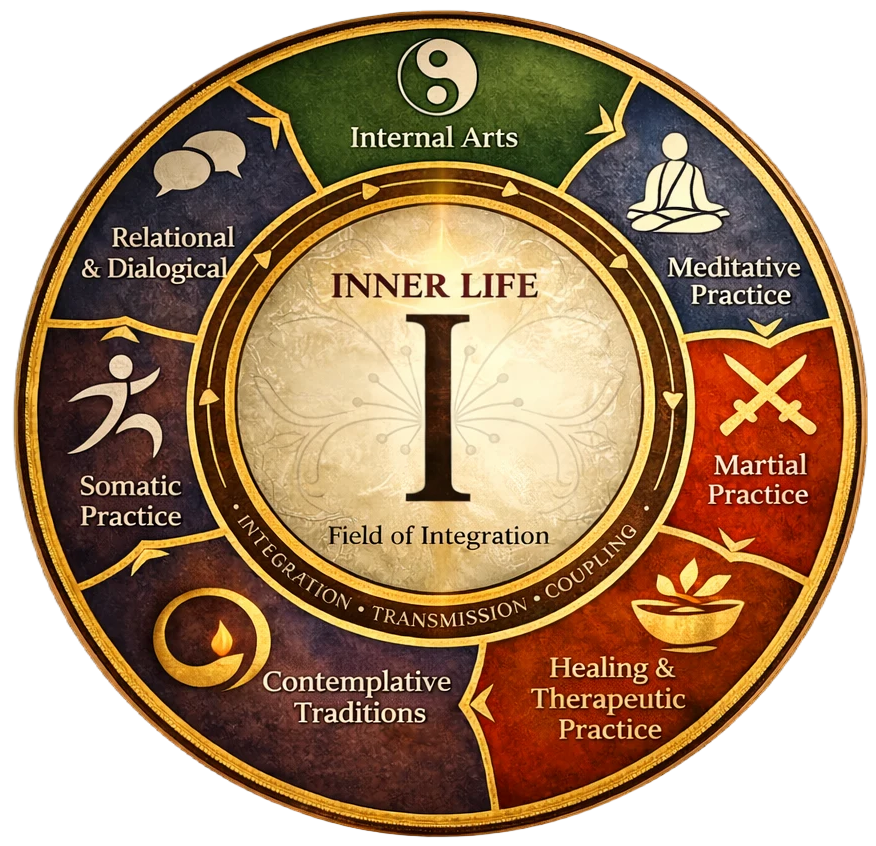
The Inner Life Ecosystem Wheel
Inner Life is a living system in which distinct domains—martial, contemplative, somatic, internal, healing, and relational—refine and stabilize one another.
Each domain develops specific capacities. Each reveals both capacity and limitation. None are complete in isolation.
These are not separate paths. They are different entry points into the same developmental process.
What matters is not where one begins, but how these capacities are brought into relationship—until the system organizes as a whole.
EVERYTHING CONNECTS
Most websites organize information by topic. Inner Life organizes it around one inquiry: how embodied practice cultivates human development. Every conversation, reflection, practice, field note, and knowledge article explores the same living process from a different perspective.
- A conversation introduces new possibilities.
- A reflection deepens understanding.
- A practice transforms ideas into lived experience.
- A field note reveals those principles through direct experience.
- The Knowledge Base connects them into one integrated map of embodied human development.
Begin anywhere. Follow what resonates. Over time, individual pieces gradually reveal themselves as expressions of one living system.
CHOOSE YOUR ENTRY POINT
Five ways of engaging the work.
Each begins differently—but leads into the same system.


Many Paths.
One Living System.
You may begin anywhere.
Inner Life reflects a broader understanding of embodied cognition, as explored in contemporary research
(see Stanford Encyclopedia of Philosophy).